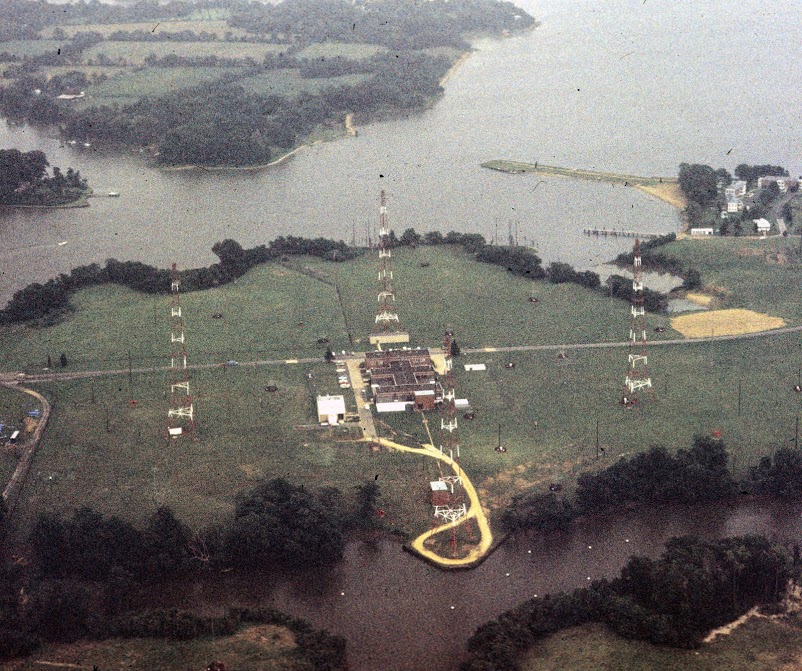
Naval Radio Transmitting Facility NRTF Annapolis - NSS
NSS Early
Photos and History from Sparks Journal - thanks to John Dilks and
Society of Wireless Pioneers
Check out Bill Heidig's photos of Annapolis
- here's a sample
In 1910, the Navy purchased a 180 ac property from Theodore
Corner, which consisted at the time of four structures and what appeared to be
an orchard (U.S. Naval Academy, Public Works Department [USNA, PWD] 1916).
Initially, the Naval Academy operated a small dairy farm at Greenbury Point.
However, this small operation failed to meet the needs of the Academy, and in
1913, the Navy moved the dairy farm to a much larger tract in Gambrills,
Maryland. The Academy subsequently established a hog farm on the 100 ac southern
portion of the former Corner parcel. This farm, which contained four dwellings,
a milk house, cook house, a hog house, four barns, and a wagon shed, was
established primarily as a means of disposing of garbage generated in the dining
halls in Bancroft Hall, located on the Academy's campus (USNA, PWD 1918;
Midshipmen's Store and Service Division 1929). The Academy prided itself on
maintaining a scientific operation, complete with hog houses, breeding
platforms, and built-in concrete troughs on the 10-ac developed portion of this
facility. The remaining 90 ac were used for pasturage, livestock exercise lots,
and alfalfa and corn production. None of the average 350 hogs raised on the farm
were utilized to feed the corps of midshipmen. Most of the excess stock was sold
to the stockyards in Baltimore, and some meat was sent to feed the unmarried
employees at the dairy farm in Gambrills (Midshipmen's Store and Service
Division l929:2 1,26).
The northern portion of the former Corner farm was developed as
a radio transmission facility. The Navy had began testing wireless apparatus as
early as 1899, and in 1900, radio stations were established at Washington, D.C.,
and at the Naval Academy itself. During the ensuing 15 years, the Navy
established additional naval shore and ship stations on both coasts, as well as
its own radio research laboratory in Anacostia, and a high-power transmitting
station at Arlington, Virginia (Gebhard 1979%; Office of the Chief of Naval
Operations 1961:3-4). With the advent of World War I, the Navy Department
assumed the responsibility for establishing and operating a transatlantic
communication system. This system included former commercial properties,
transmitting facilities, receiving stations, testing facilities, communications
schools, and additional high-power transmission stations on United States
possessions in the Pacific and in the Caribbean (Best 1996). By the end of the
war, the Navy's communications network included the highest powered arc
transmitters in the United States, and was capable of communicating with Navy
ships throughout the world (Office of the Chief of Naval Operations 1961:7-9;
U.S. Navy Department, Bureau of Yards and Docks 1921:365).
The Naval Radio Transmitting Station [NAVRADSTA (T)] at
Annapolis was established in 1917 to provide a secure communications link
between the United States, France, and England. The Annapolis site was selected
due to its remote location along the Chesapeake, as well as for its proximity to
Washington (Nimitz Library, Miscellaneous Records of the Naval Station, Box No.
1, Folder No. 6; "Radio Transmitting Facility Annapolis, Maryland",
n.p.). In 1918, the Navy entered into an agreement with France for the Navy to
construct a high-power, long-wave station in France (Office of the Chief of
Naval Operations 196 1 :9). NAVRADSTA (T) Annapolis, established in 19 18 as a
high-powered Very Low Frequency (VLF) station, was designed to operate in
conjunction with the French transmitter.
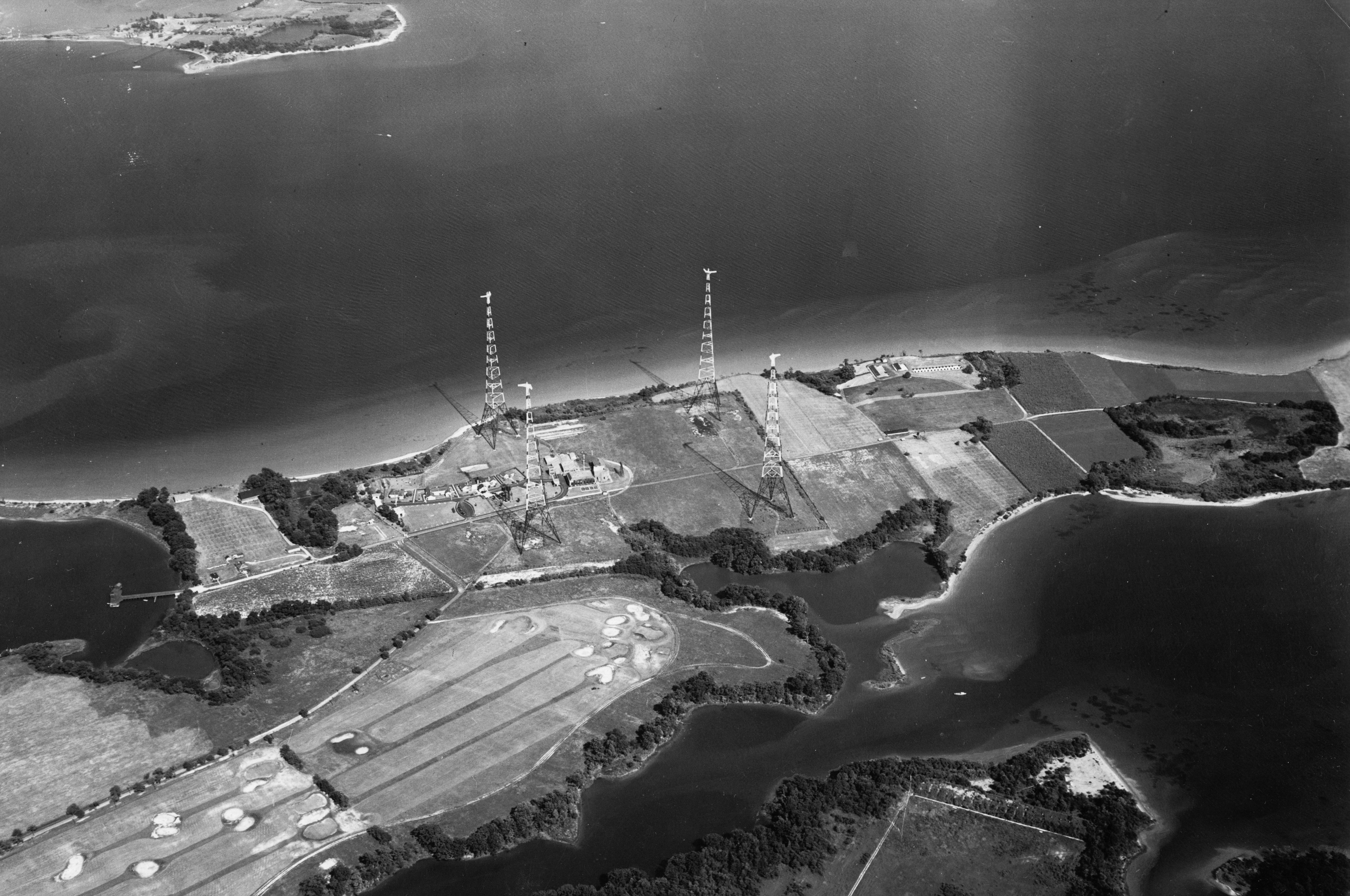
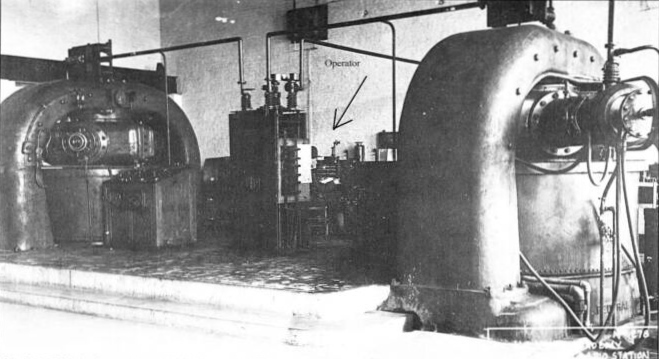
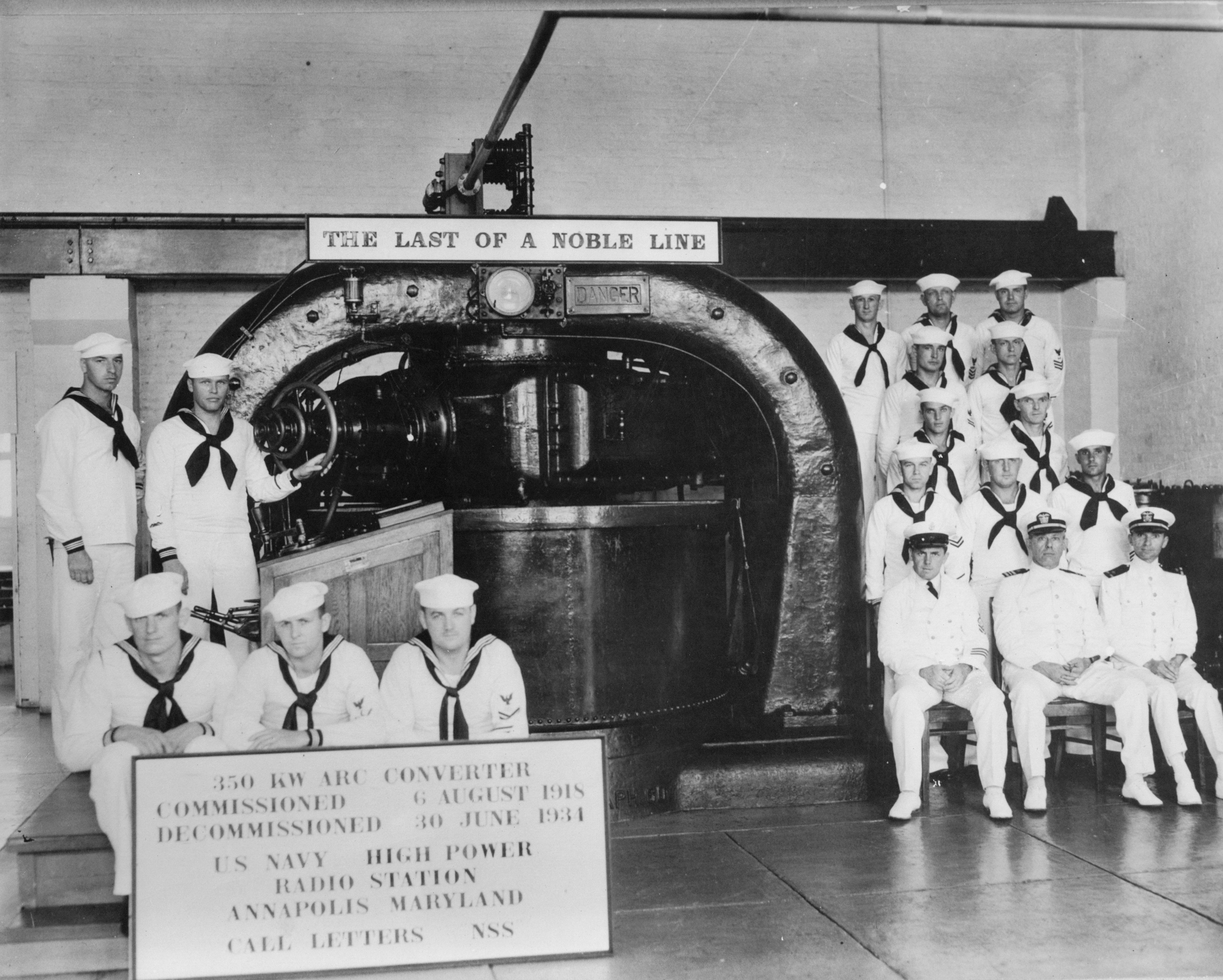
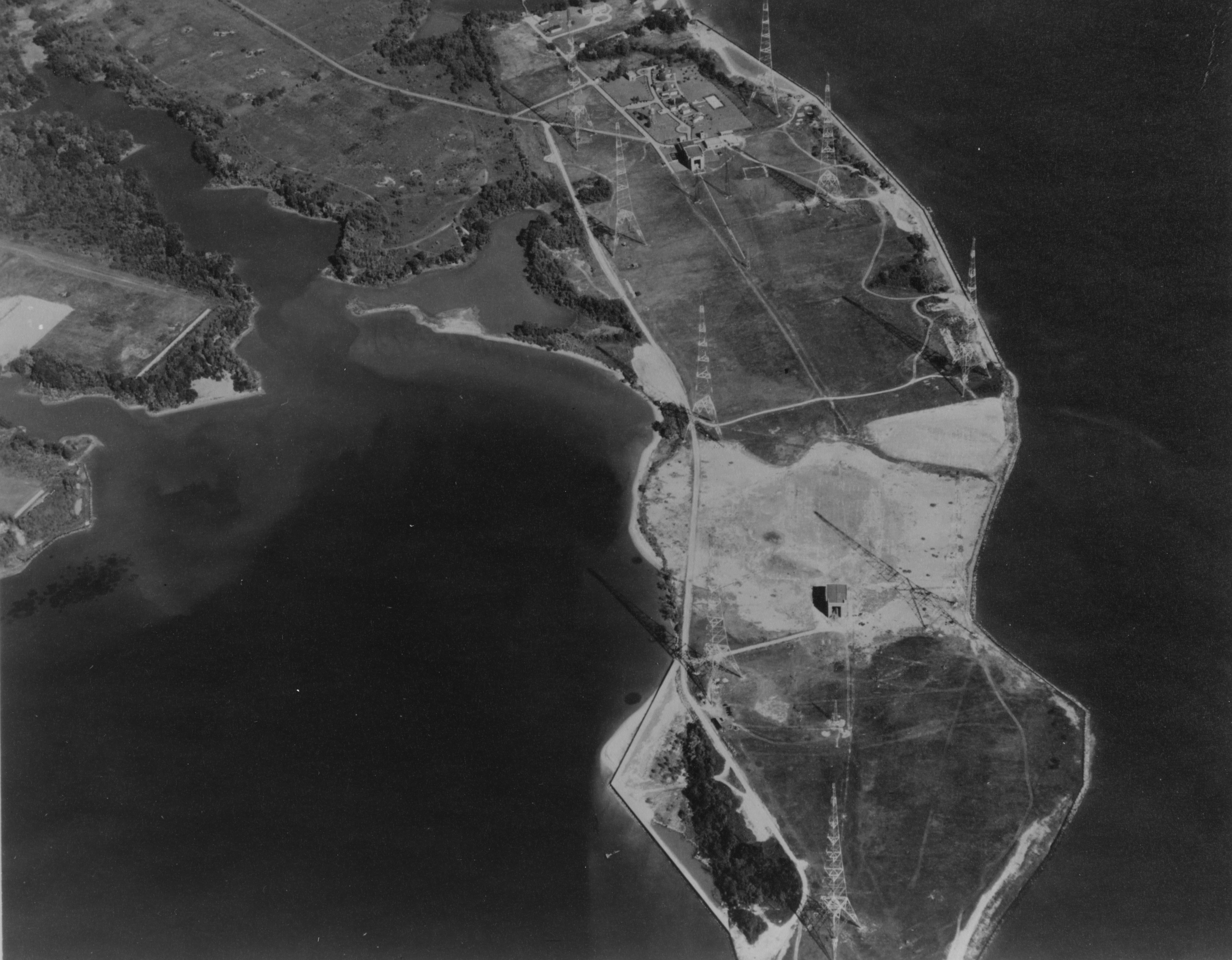
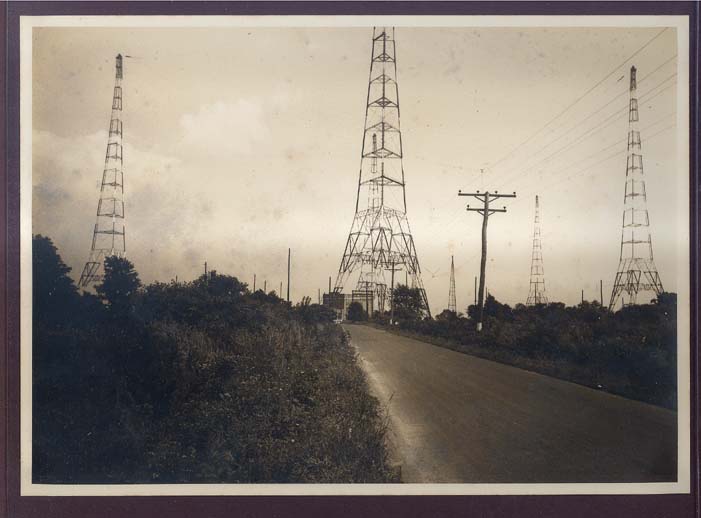
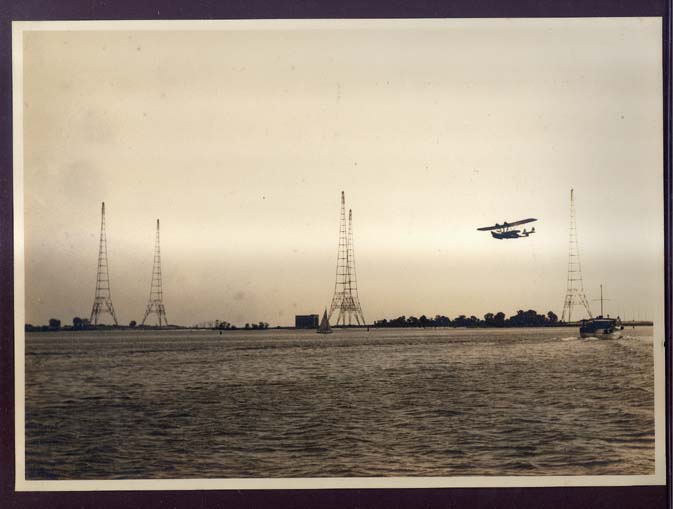
The station was commissioned in August 1918 using two 500-kw
Poulson Arc Converter VLF transmitters built by Federal Telegraph Company of San
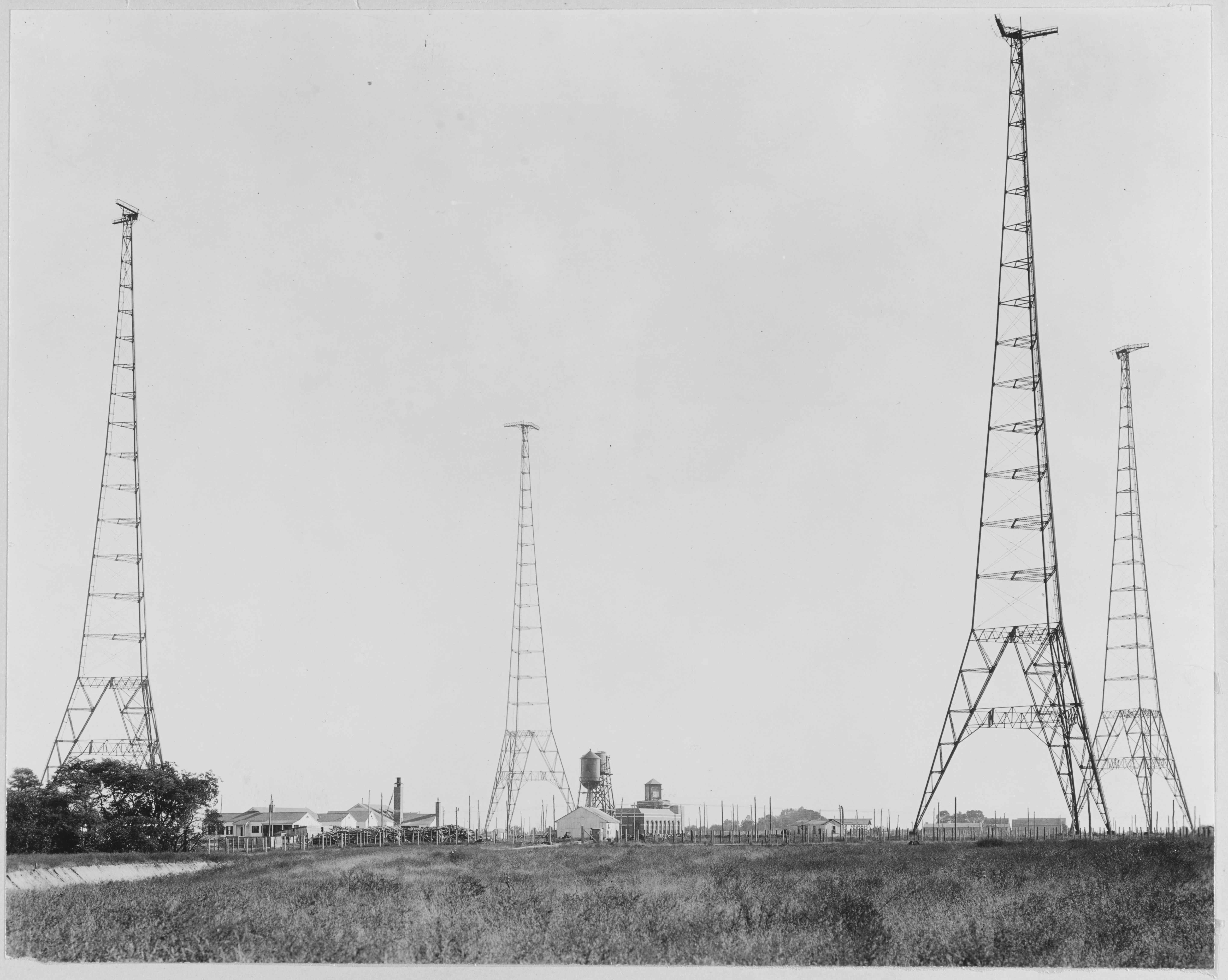
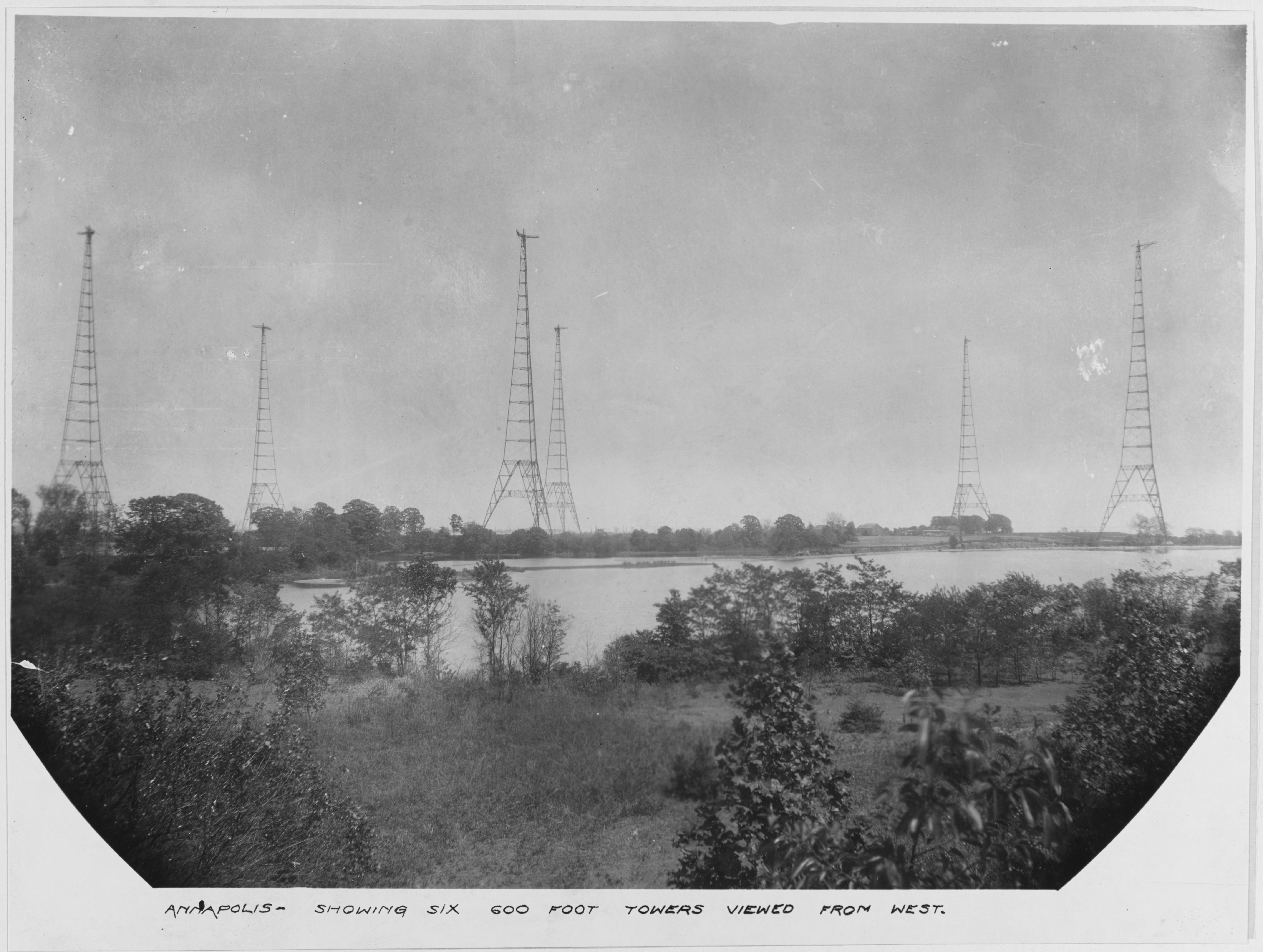
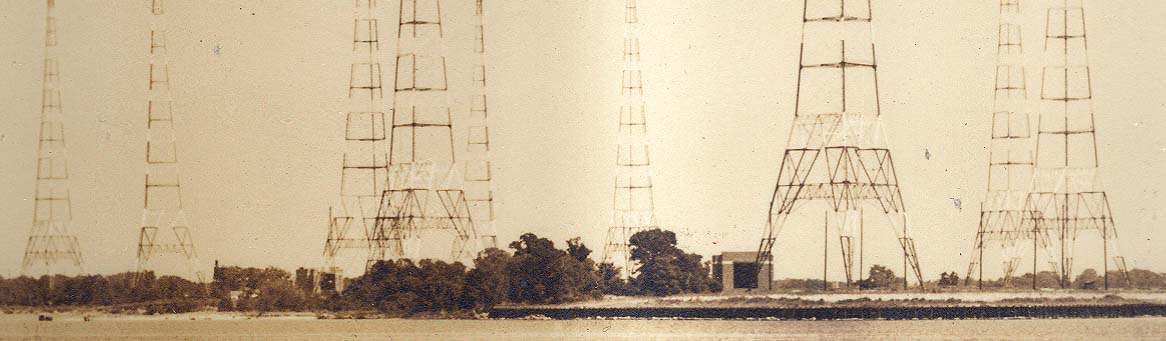
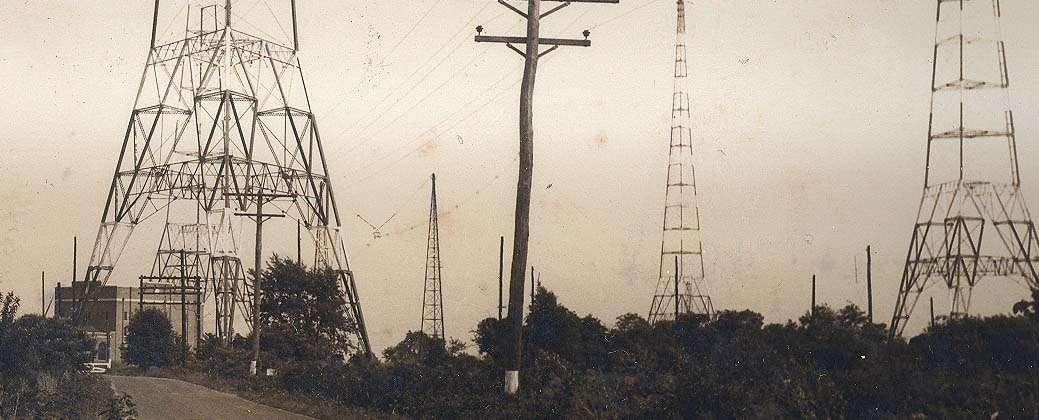
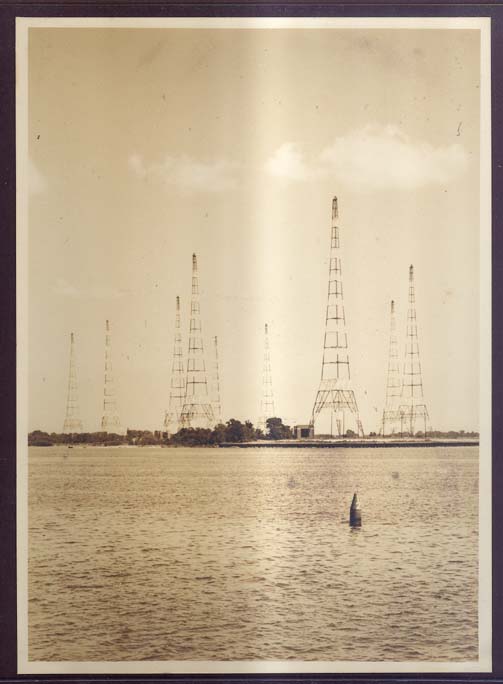
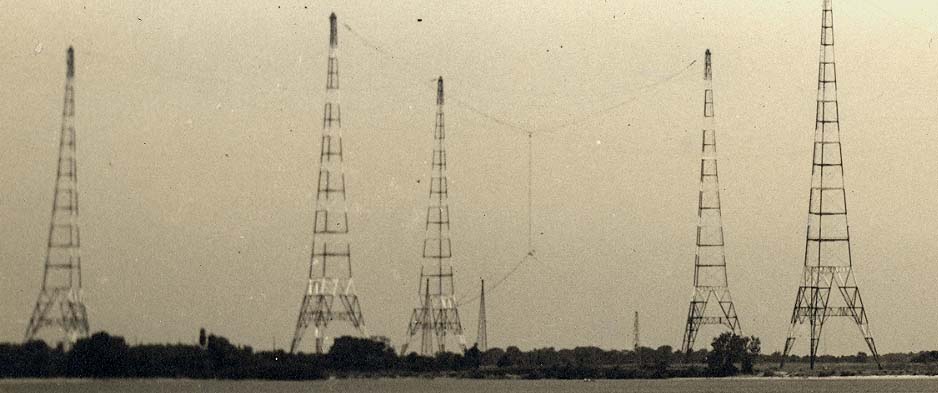
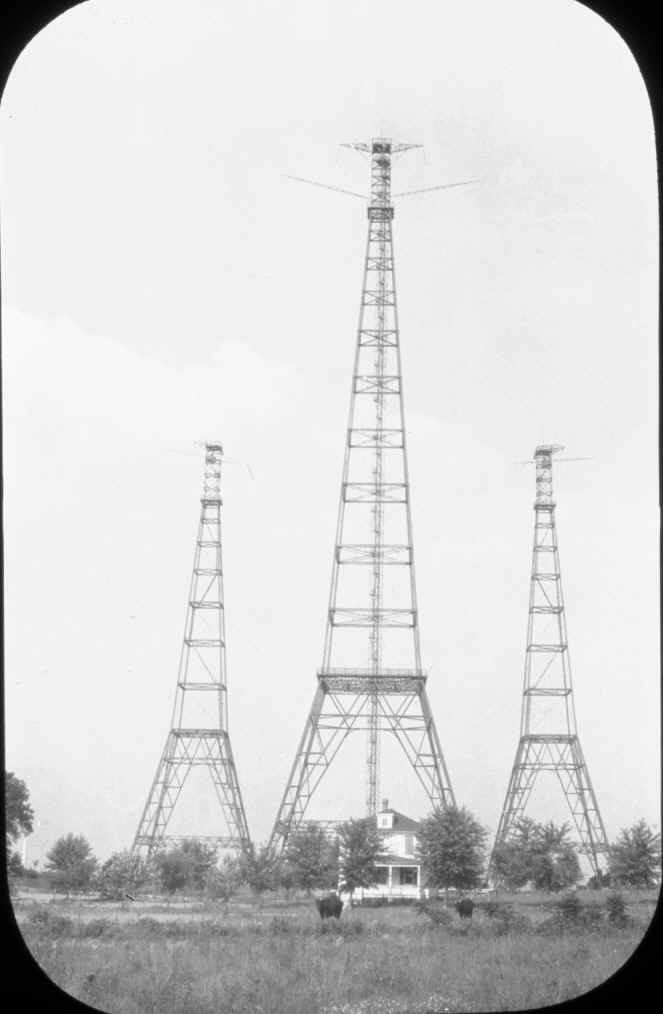
Francisco under a contract from the Bureau of Steam Engineering. Four 600-foot
radio towers (Nos. 1-4), designed by the Austin Company, were erected as part of
the original construction campaign (Nimitz Library, Miscellaneous Records of the
Naval Station, Box No. 1, Folder No. 6; "Radio Transmitting Facility
Annapolis, Maryland", n.p.). ,--- In addition to the towers, the
transmission site also contained a power house and transmitter house, an
operator's dwelling, Marine barracks, the residences of the officer in charge
and the chief petty officer, a wharf at Possum Point, and a water-supply system
(USNA, PWD 1918). The two 500-kw arcs installed in the operations building
(Building 5) provided coverage for the Atlantic Ocean, England, and Europe. The
station was completed by the summer of 1918, and the first message was sent to
France in early September (Gebhard 1979:9). At the time of its completion, the
Annapolis station was one of the most powerful in the United States and the
world (U.S. Navy Department, Bureau of Yards and Docks 1921:365-366).
The transmitter facility was expanded and modified during the
1920s. In 1922, two additional towers (Nos. 5 and 6) were constructed (Best
1996). The Marine barracks were modified to accommodate married enlisted men's
quarters, and artesian wells, septic systems, and a technical support building
were constructed. North of the fenced facility, the installation's wharves were
expanded and several barns were constructed (USNA, PWD 1928). The Naval Academy
Hog Farm continued to occupy the land south of the transmission facility.
Development of the northern portion of North Severn proceeded
along a different track during this period. The former Taylor property went
through a series of owners, including Thaddeus Davids, L. A. Palmer, and C. E.
Remson, who acquired it in 1889 (Hopkins 1878; USNA, PWD 1934). An undated
survey of this property showed that land use during this period was devoted to
agriculture. Approximately 59 ac at the northernmost point of the tract remained
wooded, while the remainder had been divided into fenced fields of 8-28 ac. Two
peach orchards were present within the property, and a residential complex of
three buildings was located overlooking Mill Creek. At the head of Carr's Creek
near the southern boundary of the property, a small portion of land was
designated as a "Mineyard;" this parcel may have been associated with
the rifle ranges then under development on the neck of land between Carr's Creek
and the Severn River (USNA, PWD n.d.). At some time prior to 1934, the Remson
farm was acquired by the Greenbury Land and Development Company, presumably for
development as a recreational or vacation complex. One small 7 ac parcel
bordering Mill Creek was owned by the Acme Realty Company of Maryland (USNA, PWD
1934).
During the 1930s, the mission of NAVRADSTA Annapolis was
expanded to include high frequency radio transmissions. During this period, High
Frequency (HF), Medium Frequency (MF), and Low Frequency (LF) transmitters were
added to support the original VLF arc converter transmitters (Nimitz Library,
Miscellaneous Records of the Naval Station, Box No. 1, Folder No. 6). In 1937,
the original VLF transmitter was replaced, and a new antenna system installed
(Nimitz Library, Miscellaneous Records of the Naval Station, Box No. 1, Folder
No. 6; "Radio Transmitting Facility Annapolis, Maryland", n.p.).
Other modifications included the addition of one new building at
Possum Point and the extension of the unpaved Greenbury Point Road from the
transmitter station complex to the southern tip of the point. In 1935, the Hog
Farm was relocated to the northern portion of the tract, between the transmitter
facility and the wharf at Possum Point (USNA, PWD 1935a, 1935b). Between 1939
and 1940, these facilities augmented fire protection capabilities at the
station. The facility also made minor infrastructure improvements with the
construction of a pumphouse (NA76), a concrete dam (NA77), and reservoir.
By 1940, the Navy's radio communication system encompassed a
global chain of high, medium, and low frequency transmitting stations, receiving
stations, and supplementary stations. The Bureau of Yards and Docks'
construction program for radio stations in the continental United States during
World War II was relatively modest, with allocations for buildings and
structures totaling $25,000,000. Additional funds allocated for new equipment
under the Bureau of Ships were used to make improvements to both west and east
coast facilities, including Annapolis. The major emphasis was directed towards
expanding overseas radio facilities at Hawaii and other advanced bases
(U.S. Navy Department, Bureau of Yards and Docks 1947:401). World War I1 forced
a tremendous expansion of the capacity of the Annapolis Station. During the war,
NAVRADSTA Annapolis became the "primary transmitting station for
communication command and control with deployed units" (Nimitz Library,
Miscellaneous Records of the Naval Station, Box No. 1, Folder No. 6). The
station's capacity was upgraded with the construction of 50 kw LF transmitters,
and a continuous "modernization plan" was instituted. The station's
pre-war complement of 24 radio operators was increased to 50 during the war, and
the number of radio transmitters almost tripled (Office of the Chief of Naval
Operations 1946:45-46).
Expansion of the facility's mission necessitated changes in land
use at the installation. The former Remson Farm property bordering Mill Creek
was acquired in 1942, and was utilized to accommodate the expanded transmission
facilities, including five transmission towers, a receiving station, a bachelor
officers quarters @JA74), and a golf course (USNA, PWD 1943a). On the
transmitter parcel itself, the site of the former hog farm was developed for
additional residential housing, and the wharf facilities at Possum Point
apparently were dismantled (USNA, PWD 1943b).
The post World War II era was dominated by increased hostilities
in Soviet-American relations and a proliferation of new technologies in
communications. Developments at NAVRADSTA Annapolis responded to and reflected
these outside influences. In August 1953, the Annapolis facility became part of
the U.S. Naval Communications Station, Washington, D.C., which consisted of a
communications center and two other radio stations (Cheltenham and Arlington).
In 1955, microwave communications were installed between Cheltenham and
Annapolis to replace telephone land lines.
Construction activity at Annapolis during the late 1940s and
1950s included a transmitter building (Building 128); a helix house; a battery
house (Building 138); a Communications Control Link Building (Building 150); an
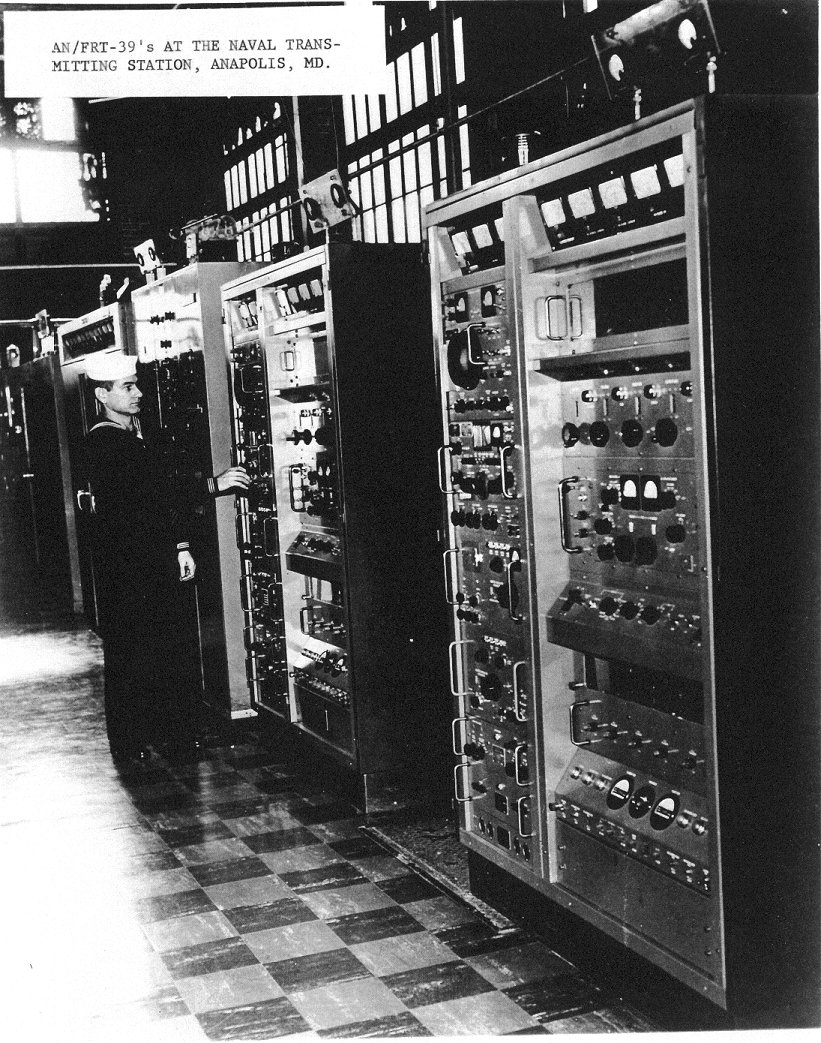
AN/FRT-4 transmitter; an 800-foot vertical radiator tower; three AN/FRT-39
transmitters in Building 60; seven AN/FRT-25 transmitters; and, Communication
Moon Relay (CMR) transmitter building (Building 151). A microwave duplex
teletype circuit also was activated with Fort Ritchie, Maryland. In 1958, a
200-foot steel tower was erected at the north end of the Annapolis radio
station, and a 190-foot steel tower was constructed adjacent to Building 60
(Nimitz Library, Miscellaneous Records of the Naval Station, Box No. 1, Folder
No. 6).
The 1960s and 1970s were a dynamic period for Annapolis, as many
of the earlier, now obsolete transmitter systems were upgraded to accommodate
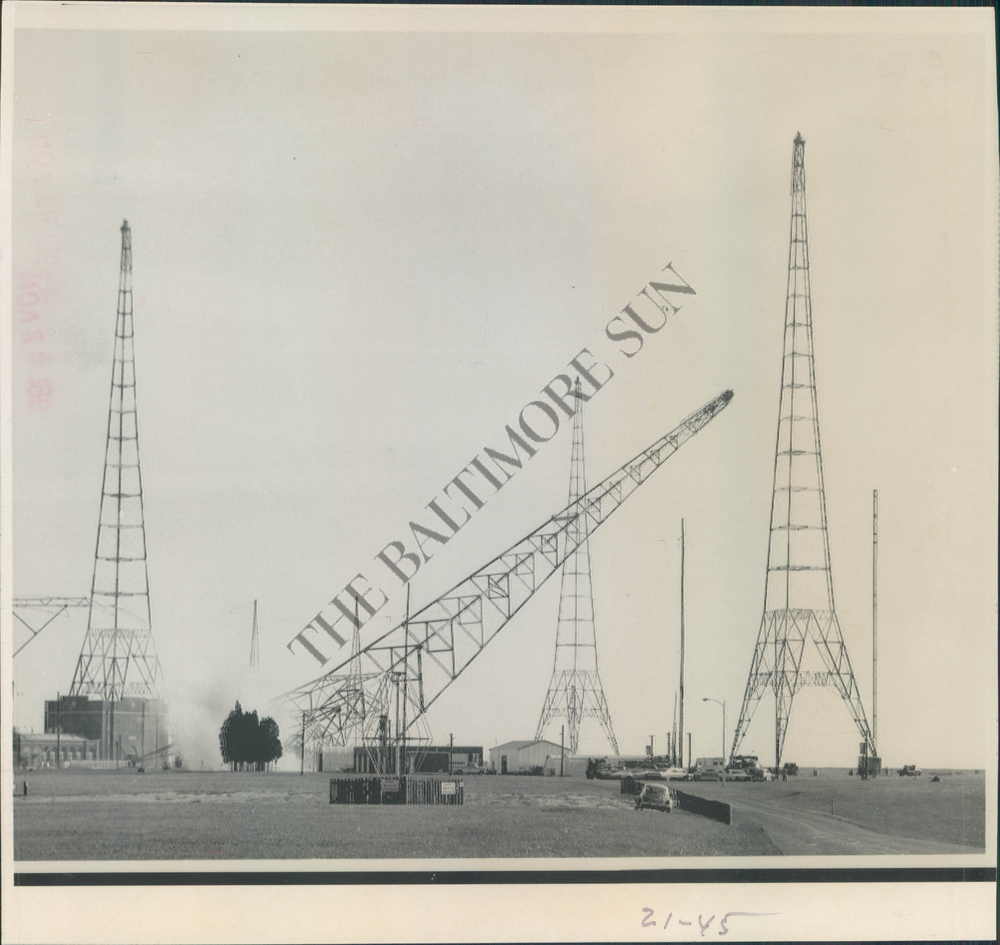
newer, state-of-the-art systems. The original 1918 radio towers (Contract
2650-1918) were demolished in 1969. Transmitters were removed or transferred to
other facilities. The Model TBJ VLF system, installed in 1938, remained in
continual use until 1969, when it was upgraded to a new system (Model AN/FRT-87
VLF) designed by Continental Electronics. The VLF system was capable of
communicating with submerged submarine 50 to 60 feet below the surface (Nimitz
Library, Miscellaneous Records of the Naval Station, Box No. 1, Folder No. 6;
"Radio Transmitting Facility Annapolis, Maryland", n.p.; J. Schorpp,
personal communication, 17 November 1995).
The station was renamed Naval Radio Transmitter Facility (NRTF)
in 1974 and became a component of the Naval Communications Area Master Station (NAVCOMTELSTA),
Atlantic. As a department of NAVCOMTELSTA, NRTF Annapolis was a vital link in
the communications system that served the fleet and the Defense Communications
Agency. The mission of NRTF Annapolis was to "operate and maintain those
facilities, equipments, devices and systems necessary to provide reliable
communications for the command, operational control and administration of the
Naval establishment ashore and afloat, and to perform such other functions as
may be directed by the Commanding Officer" (Naval Radio Transmitter
Facility n.d.).
As communications technology improved, old systems requiring
manpower were replaced with computer and satellite equipment. This allowed
manpower reductions and consolidation of space required to operate the station.
During the 1970s, the station's total acreage was reduced. The acreage
containing the golf course was transferred to USNA. When the requirement
for HF operations was eliminated in 1976 with the introduction of satellite
communications, the MF and HF transmitters at NRTF Annapolis were removed or
transferred. In contrast, an upgrade of communications equipment, communications
to the Atlantic and Mediterranean fleet units.
In 1988, the submarine base at Kings Bay, Georgia was linked
with NRTF Annapolis, providing them with LF and VLF communications capabilities
via Annapolis. In October 1988, a CVLF terminal was installed at NRTF, which was
designed to meet the needs of submarine tenders, and NATO submarine and surface
platforms (Nimitz Library, Miscellaneous Records of the Naval Station, Box No.
1, Folder No. 6).
From Naval Facilities Engineering Command History 1965-74, Chapter 10 - link
In the late 1960s the Navy decided to build a very low
frequency communications facility at the Naval Radio Station,
Annapolis, Maryland. This facility was to be used for communicating
with submerged submarines at great distances. In 1969, a
contract was awarded to build a complex of six 600 foot towers and
one 1,200 foot tower. All of these were insulated and were supported
by guy wires. (190) The total cost was $5 million. On
9 December 1971, before the contract was closed out, tests revealed
that one insulator in the central 1,200 foot tower was cracked.
This discovery led ultimately to an operation unique in the annals
of construction. In order to replace the insulator it was necessary
to place jacks under special lifting pads at the tower's
base. While preparations were being made to do this during the
winter of 1972, cracks were discovered in the weldings joining
these pads to the tower. During the spring of 1972, ultrasonic
magnetic particle testing revealed that the welds were made without
the full penetration required by the contract specifications.
Attempts were made to repair the faulty welds by rewelding but
they failed. (191)
It was deemed crucial that the cracked insulator be replaced
as soon as possible because of the dangerous stress it put on the
other insulators and because the tower was no longer insulated
and could not be used. To lessen the strain on the lifting pads
a girdle, or mechanical fix, was placed around the base of the
tower in May 1972. In June, the tower was jacked up and all the
insulators were removed, as it had been deemed advisable to install
new, stronger insulators that could better handle the 1,500 ton
load of the tower. Unfortunately the problems with the towers were
only beginning. During the remainder of 1972 and the first half of
1973, spot testing at different elevations on all seven towers
revealed further gross deficiencies in the welds, especially those
at the points where guy wires were attached. The situation was
especially critical with regard to the 1,200 foot tower. Since
this tower had no redundant parts, if even one guy wire lug broke
loose because of defective welding, the tower would collapse.
Such a collapse would have not only resulted in millions of dollars
in property loss, but would have also endangered the lives of all
personnel in the area. Under similar circumstances such tower
collapses had already occurred so there was little doubt that the
weakened tower system should be removed. The risk of collapse
was simply too great.
Only two viable courses of action were left open to the Navy -
repair the tower as it stood, or dismantle it and rebuild at a
later date. The first course of action was hazardous and would
require the most exacting calculations if the collapse of the
tower were to be avoided while repairs were in progress. It called
for a systematic detensioning on the tower's guy wires so that the
welding on the defective guy-wire mountings could be redone.
Since no part of the tower guy-wire system was redundant, if one
wire was detensioned, then other wires also had to be detensioned
to varying degrees to keep them from pulling the tower over. Such
an operation required not only an incredibly complex series of
exacting calculation, but also needed skilled welders willing to
work at great heights. The second alternative, that of dismantling
and rebuilding, was safer, but also was prohibitively expensive.
Whichever course of action was chosen, the decision had to be made
quickly as the corning winter's storms would put still greater
strain on the already weakened structure. The Naval Facilities
Engineering Command chose the first course of action after an
analysis of the risks and expense involved in both showed it to
be the least disadvantageous of the two.
Welders with the requisite skills were found and the detensioning
calculations were made. During the remainder of the summer
of 1973 the necessary repair work was undertaken. Welds were redone
at elevations of 600, 900 and 1,200 feet. (192) These repairs were
completed by 22 April 1974. In May 1974, new insulators were installed
under the jacked-up tower and in July 1974, the antenna,
now fully operational, went on the air.
This incredibly delicate operations was a resounding success,
not a man was lost and the tower was saved. The cost of the repair
operation ran about $1.5 million, but the Command hoped to recoup
this loss through litigation with the contractor. The VLF,
Annapolis story is a chronicle of both failure and success.
Failure in the sense that the original construction was fatally
flawed. Success in the sense that the Command was able to save
the project by means of brilliant engineering and decisive
remedial construction work.
190 Interview with Dr. M. Yachnis, NAVFAC Engineering and
Design, Code 04B, 28 May 1975.
191 Yachnis interview.
192 "Sequence of events associated with the VLF Antenna (1,200
ft), Annapolis, Md" (undated chronology), p. 2; M. Yachnis,
"Fifty-year
Development of Naval Facilities Construction" Journal of the
Construction Division, ASCE, Vol. 101, No. CO 1, Proc. Paper 11175
(Mar 1975), pp. 15-27.
"NSS - Still Going Strong on VLF" - by Robert J. Gleason
Sparks Journal 1982 -
Although not as old as NAA, NSS is still in operation on VLF. In fact, it is the oldest continuously operating very low frequency station in the entire world!
NSS is located on the small peninsula known as Greenbury Point on the northeastern shore of the Severn River, directly across from the United States Naval Academy at Annapolis, Maryland.
The ground on which it is located was part of the estate known as "Hammond's Inheritance of 1737" and the 500 acres were purchased by the U.S. Navy in 1910 for a dairy farm for the Academy. Price, $49,500! From 1911 to 1917, part of this site was also used for the first Naval Air Station.
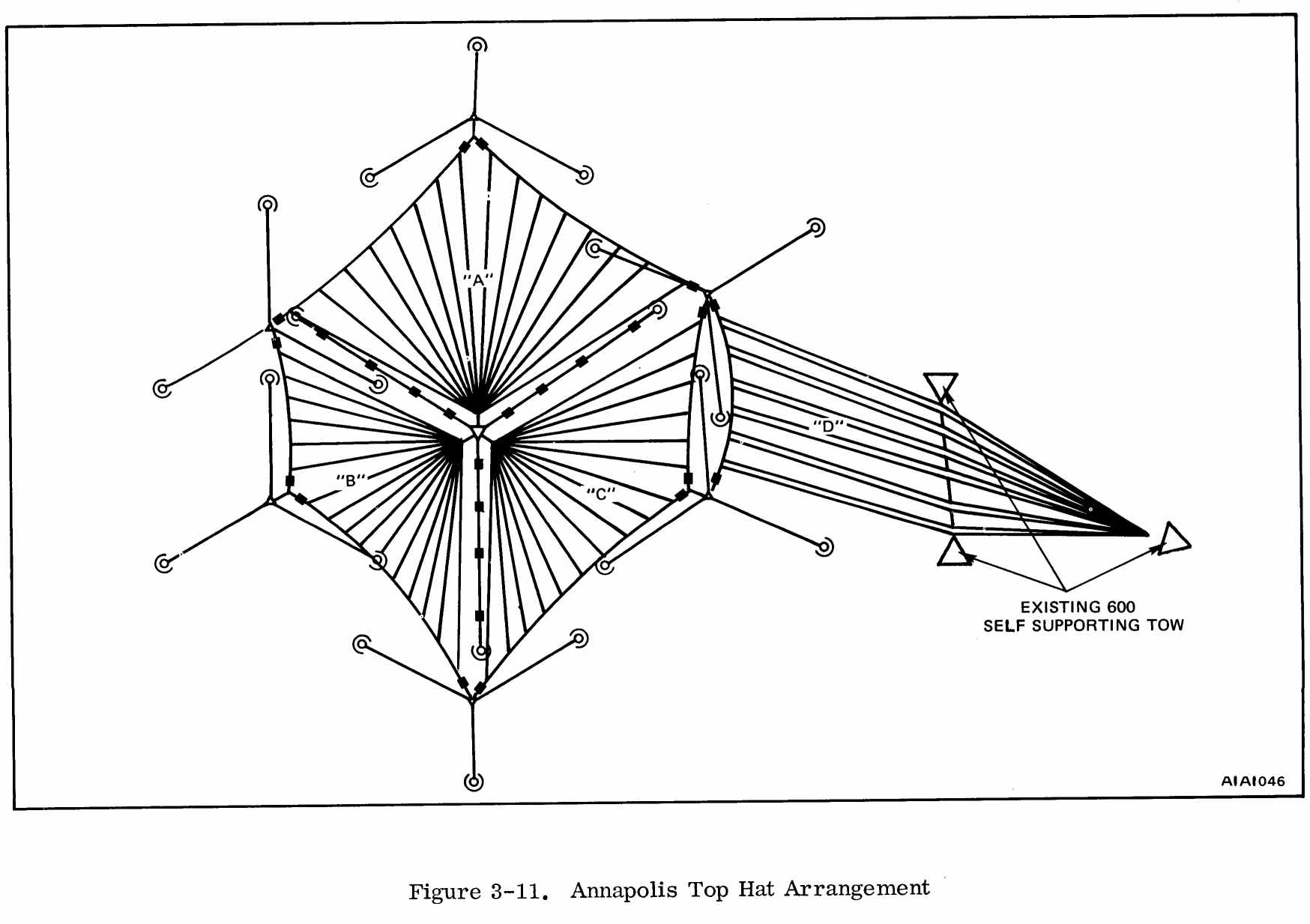
It was not until World War I that NSS came into being. Early in that war it was recognized that additional dependable radio communication to Europe was essential so new stations were planned for the U.S. and France. The site selected for the east coast high power VLF transmitter was Greenbury Point. Under wartime pressure, six 600-foot self-supporting towers were fabricated and erected and the ground system consisting of 35 miles of copper wire was installed. The huge flat top aerial was hauled up between the towers with a center downlead. Transmitter, power plant and quarters buildings were completed, a dock was built for coal delivery to the power plant, etc. -- all in less than 18 months. The station was commissioned August 6, 1918.
Two transmitters had been installed to insure continuous operation. They were 350 kilowatt Fessenden arc transmitters designed and built for the Bureau of Engineering, Navy Department, by the Federal Telegraph Company.
The receiving facilities and control point were located in the Navy Annex building near the Potomac River in Washington, D.C., about 30 miles away.
The two arc transmitters continued in service until 1931 when one of them was removed and replaced by a General Electric Company Type TBJ 500 kilowatt tube transmitter. Later, LF transmitters were added, also many high power HF transmitters, with additional buildings and antennas scattered over the site and the adjacent area which had become the Naval Academy's golf course. But the vital VLF operation never stopped and many operators will remember well the time ticks, weather bulletins, hurricane warnings and press sent from NSS.
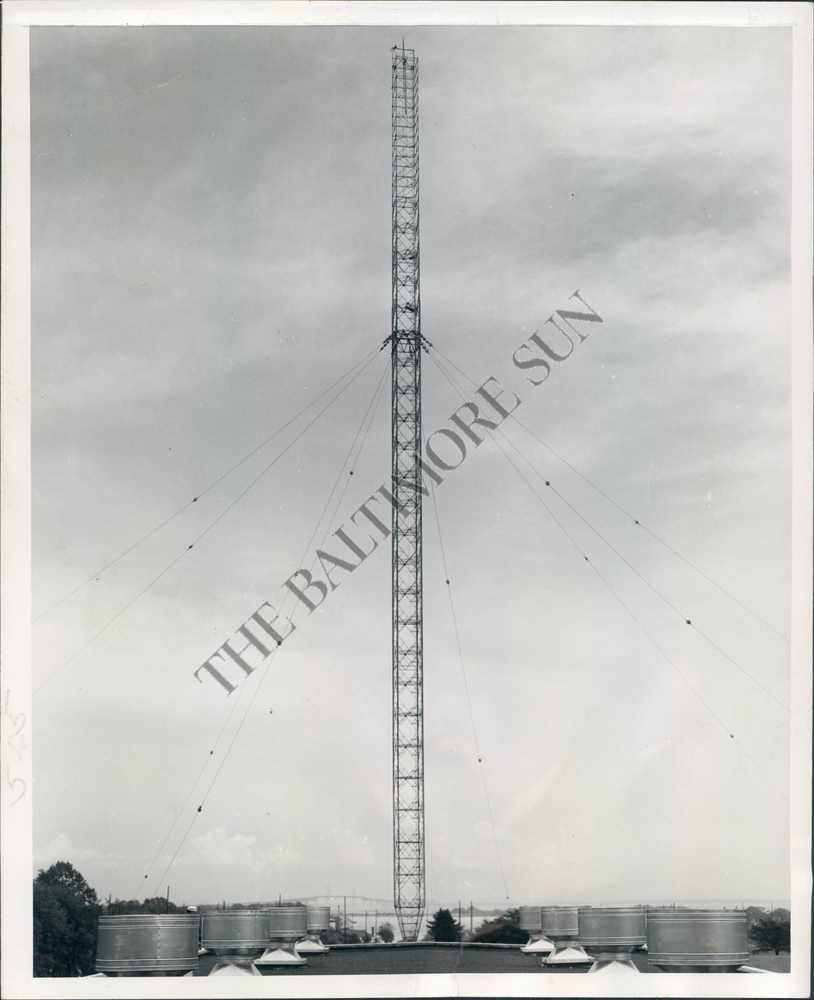
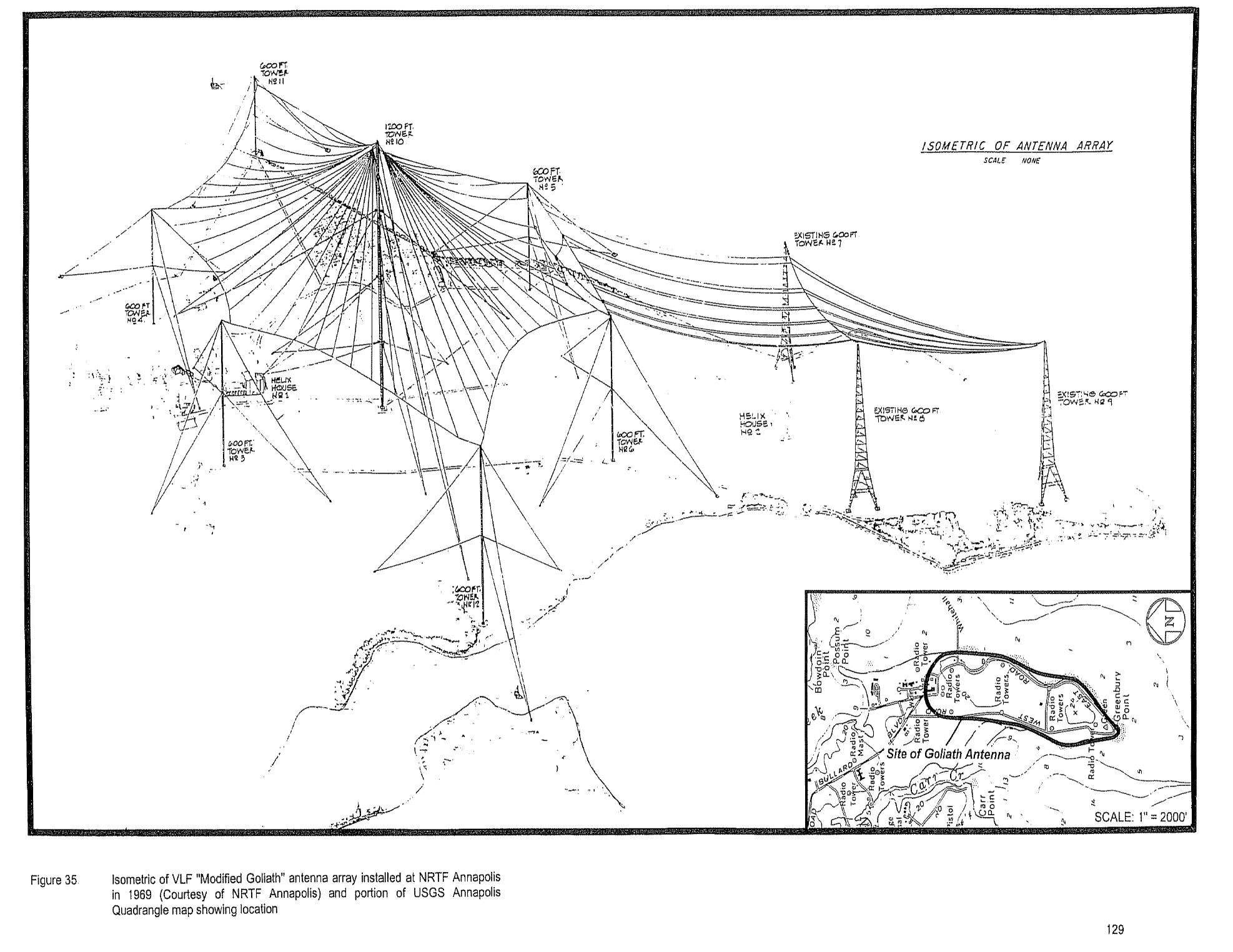
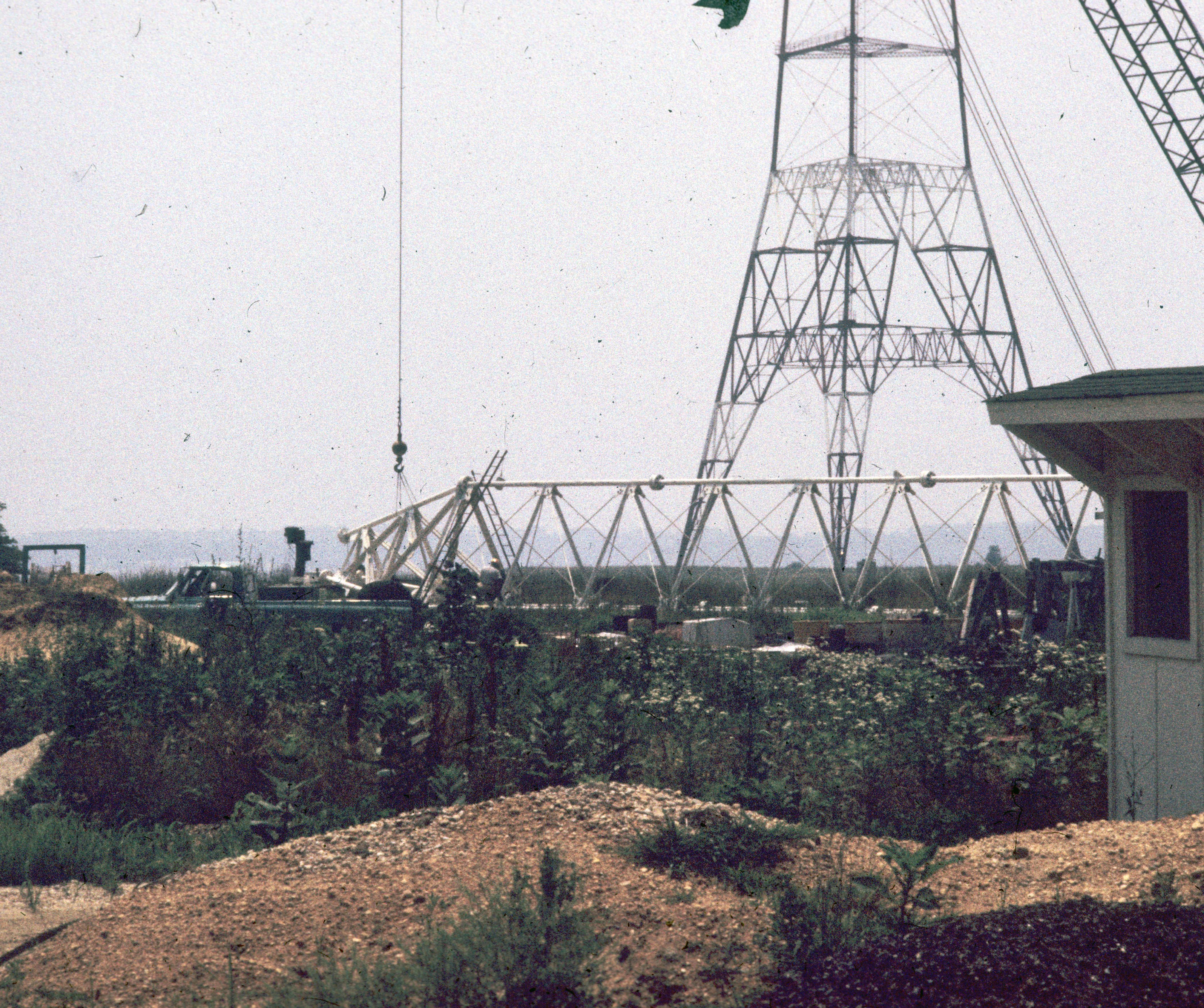
In 1969, extensive modification and improvement of the VLF antenna system was begun. A new 1200-foot guyed center tower was erected and surrounded with nine 600-foot towers (three of which are identical to those erected in 1917). The modified "Goliath" antenna consists of the 1200 tower and the "top hat" assembly supported by the 600-foot towers, covering about 200 acres. A single ceramic insulator supports the entire system which weighs "about as much as a destroyer." The output from the transmitter coupling coils is fed to the center tower at the 300, 600 and 900-foot levels and these "lead-ins" are a part of the complete antenna system.
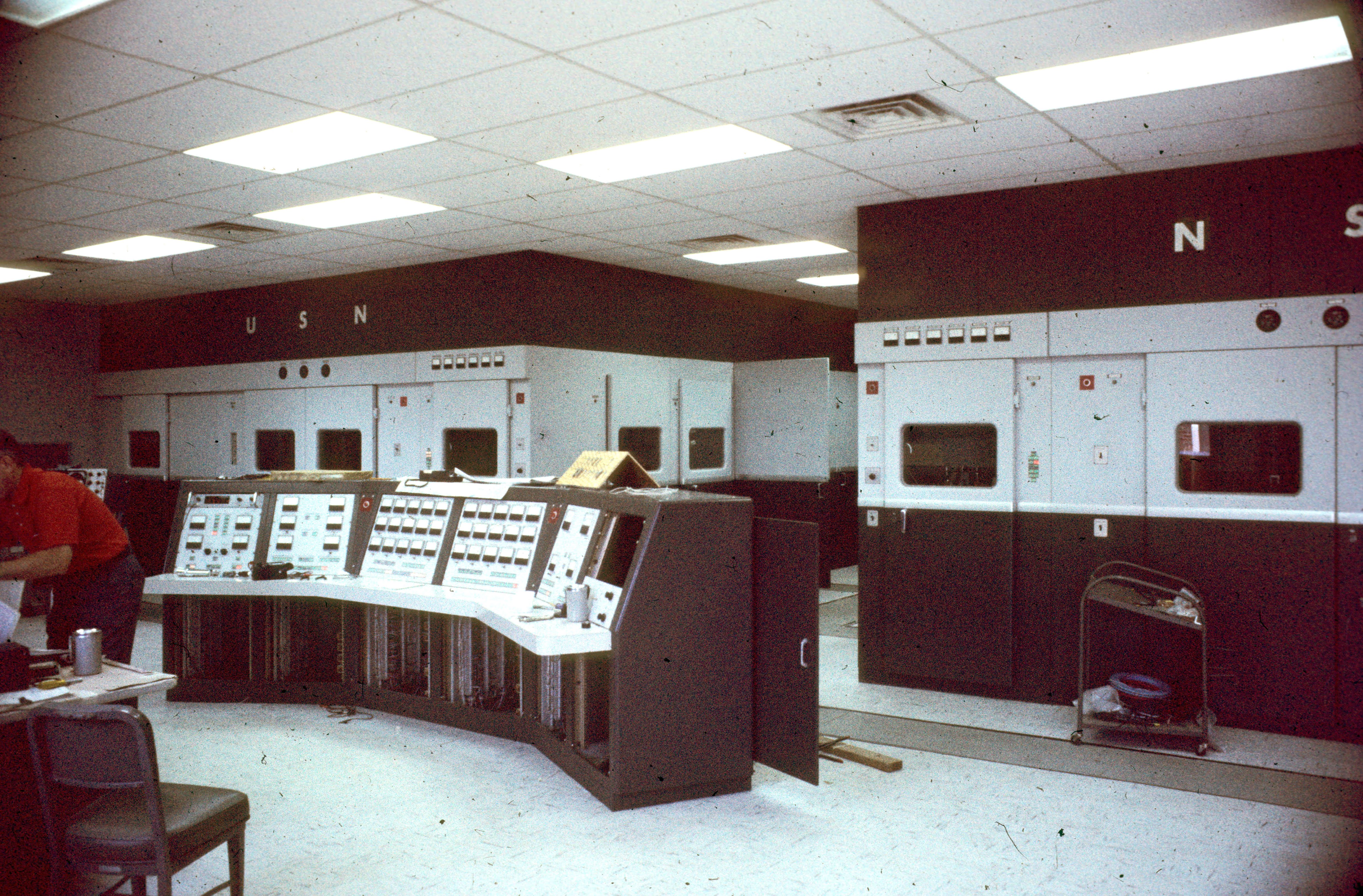
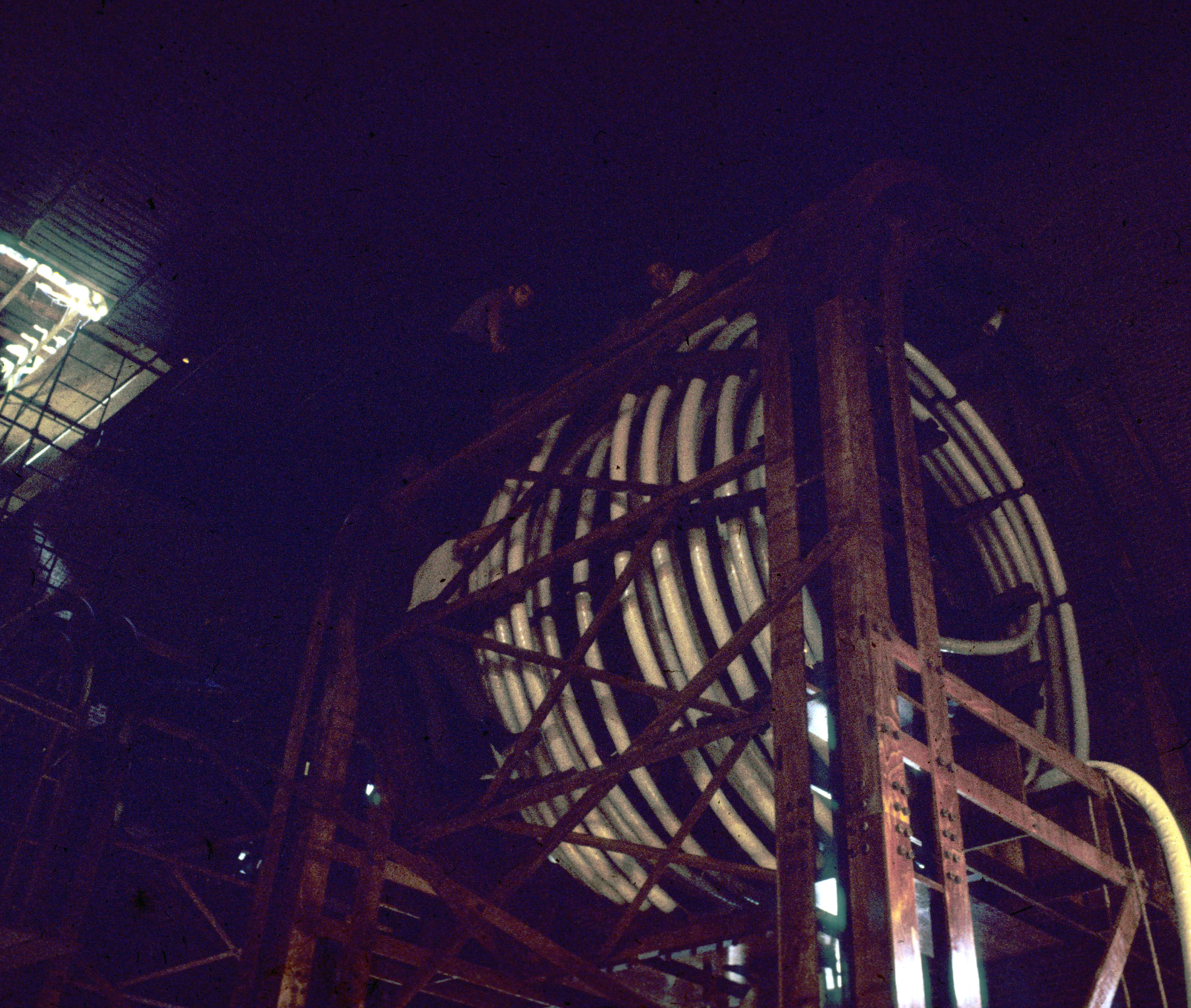
To power the new VLF antenna a 1000 kilowatt AN/FRT-87 transmitter was installed in the original transmitter building. This huge transmitter purchased from the Continental Electronics Manufacturing Company occupies the entire building, which is 75 feet wide and 145 feet long, with the output fed directly into the coup1 ing coils in the adjoining "he1ix house" which is 75 feet square and 65 feet high. These huge variometers (there are two of them in series) take up most of the space in this large building, as each is 35 feet high. They are wound with 4.4 inch diameter. Litz wire and carry about 1300 Amperes. (Yes, four and four tenths inch Litz wire!)
The AN/FRT-87 transmitter uses four 250,000 watt tubes in push-pull in the final amplifier. Additional tubes are alongside each pair as "hot spares" which can be very quickly switched in if needed. These tubes are manufactured by Eimac and presently cost $11,000 each. The 17,500 volt D.C. plate supply is provided by solid state rectifiers. The tubes are kept at proper operating temperature by circulating and cooling 700 gallons of distilled water per minute.
Although HF was phased out at Annapolis a few years ago, the VLF and LF operation has continued uninterrupted. In addition to the VLF, three powerful transmitters continue on LF. For LF, an 850-toot vertical radiator and two "flat top" antennas between three 300-foot towers are used. A fourth 300-foot tower is used for microwave systems connecting the facility with various locations.
Two auxiliary power plants each with 200 kilowatt alternators insure constant power supply. The auxiliary plant's big diesel engines are manufactured by General Motors and are the same as used on their railroad locomotives.
Today the mission of the NSS Navy Radio Transmitting Facility is to provide fast, reliable and secure communications for our submarine units 1n the Atlantic and the Medifterranean. Specially designed sophisticated multiplex transmission equipment is used and all traffic is computer encrypted. Although NSS is going stronger than ever, with a terribly vital mission in this nuclear powered world, sad to say, the call letters NSS are now never transmitted.
The Naval Radio Transmitting Facility is presently staffed by about 70 military and civilian personnel under command of Lt. Commander Samua1 G. Curry.
Danny G. Cartwright, Electronics Technician Senior Chief Petty Officer is the maintenance Chief in charge of the VLF installation and the man responsible for keeping it on the air. I am deeply indebted to him for digging into the historical files, procuring and taking photographs and "showing me the works."
As an old radioman and engineer, I am proud to see a great radio station continuing to serve our country efficiently and effectively.
Naval Radio Transmitter Facility Annapolis
Naval Station, North Severn, Annapolis MD
Greenbury Point is managed as a conservation area and is presently used for
light midshipmen tactical training. The Radio Transmitter Facility at Greenbury
Point was ordered to close, per BRAC ‘91. The the 231 acres of land and
existing facilities, except the towers, at Greenbury Point conservation area at
North Severn (formerly the Naval Radio Transmitting Facility (NRTF)) has been
transferred to the US Naval Academy in September 1994. The undeveloped areas are
being managed as wildlife habitat; therefore, human access is limited. Residents
of Greenbury Point housing have free access to their homes and surrounding area
except the East and West Roads and undeveloped areas.
During the Cold War, Greenbury Point was a key communications center for the
Navy's submarine fleet. The antennas transmitted Very Low Frequency signals
capable of penetrating the ocean, allowing communications with submerged
submarines. By the early 1990s, with advances in satellite communications, the
antennas became obsolete.
Greenbury Point was the site of the original settlement in the area, now mostly
submerged by the Severn River. It was called Providence and was established by
Puritans seeking religious freedom in 1649.
The property -- called "Hammond's Inheritance" -- was purchased by the
Navy on August 21, 1909 for use as a dairy farm. From 1911 to 1917, part of this
site was also used for the first Naval Air Station. In August 1911 a handful of
Naval officers received orders to report for duty at the Engineering Experiment
Station at the Naval Academy “... in connection with the test of gasoline
motors and other experimental work in the development of aviation, including
instruction at the aviation school.” The site of the aviation camp at the
Academy was Greenbury Point. The Greenbury Point station has not come in for its
fair measure of recognition in the history of Naval Aviation. It was a very
small affair, and it shared its location with the Academy as its host.
Nonetheless, its establishment was a landmark event, It was the Navy’s first
air station and it was at Greenbury Point that the Navy began to conduct its
first formal aviation training program. Pensacola, known as "The Cradle of
Naval Aviation," succeeded the "naval air encampment" at
Greenbury Point as the training site for naval aviators in 1914.
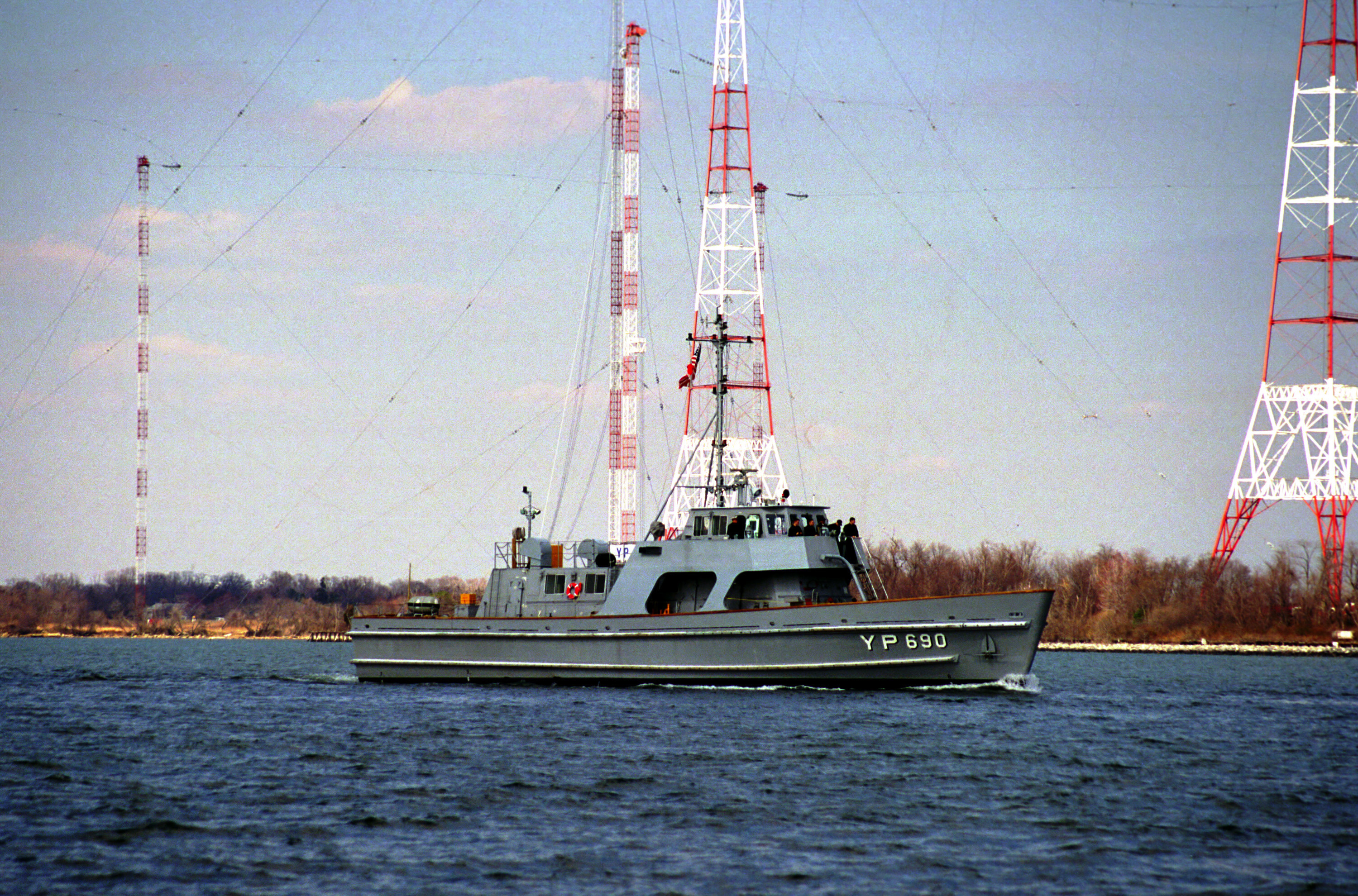
The Navy first built the four of the most northern radio towers on Greenbury
Point in 1918 to communicate with US forces fighting in World War I. The
transmitter, with call letters NSS, went on the air on 06 August 1918. The
Annapolis transmitters operated in conjunction with a large antenna receiver
facility at Cheltenham, MD. Two additional southerly towers were erected at
Annapolis in 1922. In August 1938, the erection of three "Eifel
Towers" (1G7, 1H7 and 1T9) was completed. In 1941, Building #60 was compled,
a 50 kW L.F. transmitter were installed and high frequency operations
established. The station was used for all communications with the Atlantic Fleet
during World War II.
Extensive modification and improvement of the VLF antenna system was begun in
1969. The old 600-foot radio towers on Greenbury Point were demolished to make
way for a new communications link with vessels of the Atlantic fleet. A new
1200-foot guyed center tower was erected and surrounded with nine 600-foot
towers (three of which were identical to those erected in 1917). The modified
"Goliath" antenna consisted of the 1200-foot tower and the "top
hat" assembly supported by the 600-foot towers, covering about 200 acres.
To power the new VLF antenna a 1000 kilowatt AN/FRT-87 transmitter was installed
in the original transmitter building.
Since the radio towers had no operational requirement and the Naval Academy has
no mission requirement for the towers, the disposal action for the antenna
towers was the responsibility of the Naval Computer and Telecommunications
Command (NCTC) under MILCON project P-501.
The demolition of the towers had political implications. A Senate appropriation
staffer attempted to allocate funding to this project; however, he also tried to
place language in the appropriations bill that would limit the use of the
property to only conservation and any changes require Congressional approval.
The staffer was informed that this is not acceptable to the Naval Academy.
The demolition of the naval radio transmitting facility (NRTF) towers at Naval
Station, Annapolis was initially projected to include demolition and removal of
19 antenna towers, antenna arrays and guys, the excavation and removal of a
causeway in the Chesapeake Bay, and incidental related work. The towers to be
demolished include: Six 600 foot towers supported by 2 levels of 3 guys, Three
600 foot freestanding Eiffel-style towers, One 1200 foot tower supported by 4
levels of 3 guys, Four 300 foot freestanding towers, One 800 foot tower
supported by 1 level of 8 guys, Three 80 foot triangular towers with rigid
conical antenna frame supported by rope guys, and One 66 foot freestanding
download terminal tower. Six tower guy anchors located in the Bay were removed;
and all other tower foundation/anchors and the radial grounding systems remained
in place. The base insulator for Tower No. 10 was salvaged and turned over to
the Government. The work also included removal of 4 HF curtain array antennas
and supports. These include a total of approximately 20 wood pole supports, 55
guy cables, 250 foot (plus or minus) length of 2 foot wide wood access piers,
and 60 (plus or minus) wood dolphin poles. The naval station, primary school and
golf course remained in operation during the entire demolition period.
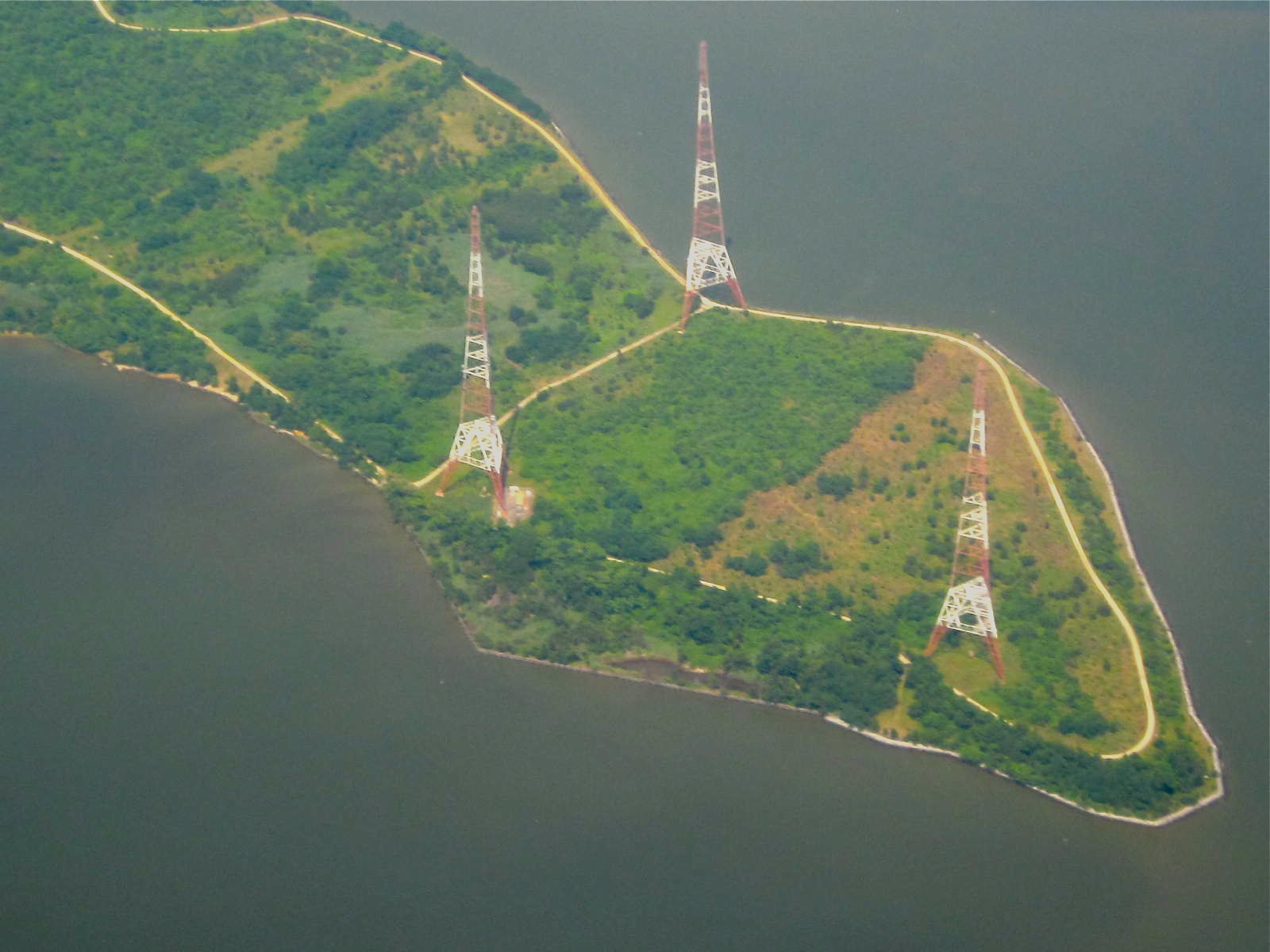
The final demolition of 16 of the 19 former Navy radio towers on Greenbury Point
took place on 09 December 1999. Three towers remained standing and were turned
over to Maryland or Anne Arundel County for telecommunications or training
purposes.
The undeveloped area of Greenbury Point is being managed as a environmentally
sensitive conservation area and is the surface danger zone for the Naval Station
rifle ranges. In the developed area, the facilities are occupied by Construction
Battalion Unit 403, a Bachelor Enlisted Quarters, Married Enlisted Quarters
(being used as swing space during NavSta BEQ Renovation), and a soon to be
renovated Environmental Nature Center.
There are no planned changes to the facilities or land usage at Greenbury Point.
An updated Integrated Natural Resources Plan and a Facilities Master Plan are
being developed to manage this area. Greenbury Point has a variety of other
habitats including wooded coves, shallow wetland ponds, forests and scrub/shrub
areas. Many interesting wildlife make this area their home. For example,
Greenbury Point supports the only bobwhite quail population in Anne Arundel
County, Maryland.
US Fish and Wildlife Service staff developed a Natural Resources Management Plan
for the Annapolis Area Complex of the Navy, which includes the Naval Academy,
the North Severn Complex of the golf course and Greenbury Point and the Naval
Dairy Farm in Gambrills, Maryland. The Service’s restoration and environmental
education experts assisted the Navy’s natural resources manager by evaluating
Navy lands and writing a plan for the future of conservation areas and natural
habitats under Navy management.
Greenbury Point, a 231 acre peninsula at the mouth of the Severn River, provides
numerous opportunities to integrate wildlife habitat and education with the
training mission of the Naval Academy. Outdoor education planners from the
Service's Blackwater National Wildlife Refuge are lending their expertise to
help shape the Visitor’s Center Environmental Education facility the Navy is
currently building on Greenbury Point. Nineteen osprey pairs that nested on
Greenbury Point’s radio towers were provided new platforms before the towers
were demolished